Building Hoofflix: What Happens When a Marketing Job Turns Into a Partnership
I was brought in to help with marketing. I ended up rebuilding an industry's entire professional platform and putting my own name on it. This is how that happened.
I Was Brought In to Do Marketing
That was the job. Hoofflix had content, an audience, and a founder with real authority in his field — Dr Mark Caldwell FWCF, a Fellowship farrier who has spent a career on the science of the equine foot and who, with Neil Madden FWCF, literally wrote the book on it. What it didn’t have was traction.
I lasted about a fortnight before I had to go back and tell him the marketing wasn’t the problem.
That’s an awkward conversation to have two weeks into a paid engagement. You’re talking yourself out of the work you were hired for and asking for something much bigger instead. Usually it ends the relationship.
But I’m no good at the other way round. If I believe in something I’ll sweat into it, and by then I’d seen enough to believe in this.
Why He Listened
I’m a farrier as well as a developer.
So when Mark talked about medio-lateral balance or a broken-back hoof-pastern axis, I didn’t need it explained. I’d stood under horses. I knew what a six-week cycle actually looks like, and why an owner saying “but I read online that…” is the most draining part of the week.
It wasn’t the usual conversation, where a technical person explains what’s possible and a subject expert tries to compress their life’s work into requirements. We were two people in the same trade, one of whom could also write software.
Not a spec. A shared language.
What I Actually Found
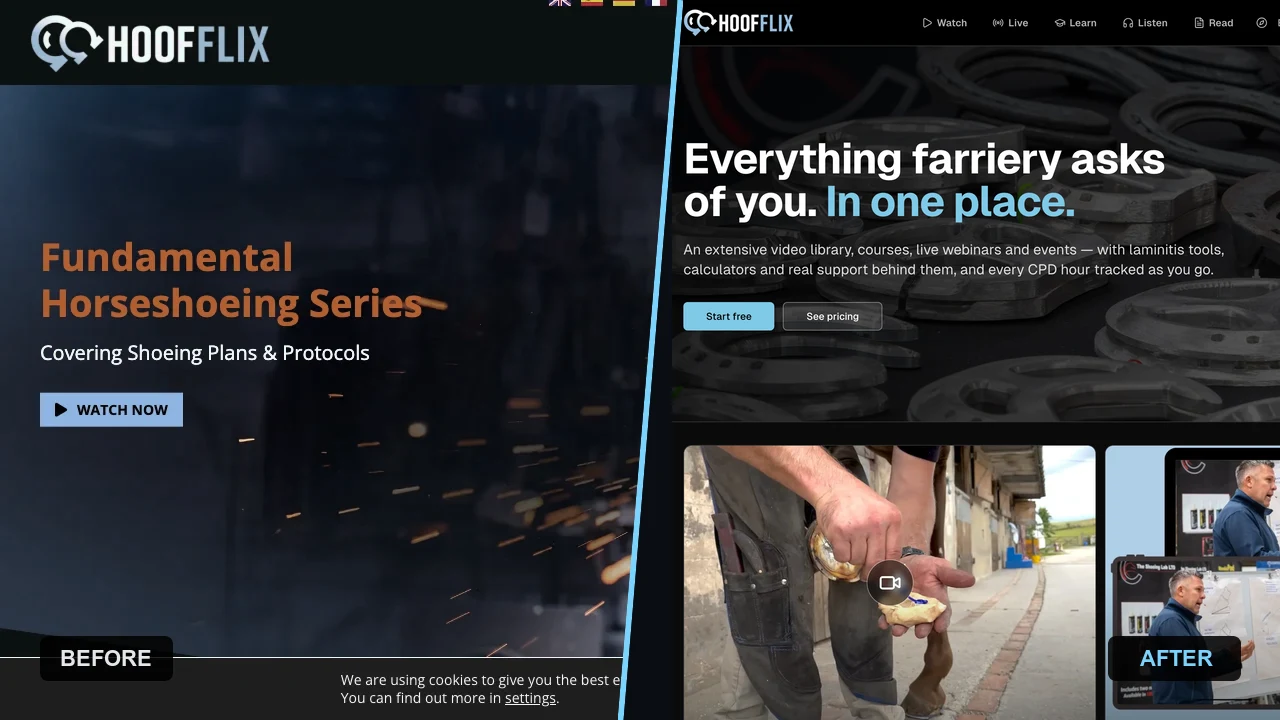
“Hoofflix” wasn’t one thing. It was two WordPress sites with a scattering of accounts round the edges.
hoofflix.com was the home of the video — hundreds of hours of teaching library sat behind a members’ area, billing through subscriptions set up years earlier and never touched since.
scientifichorseshoeing.co.uk was a separate site entirely, with one plugin bolted on for the courses and another for the shop.
And the articles were on both. Not divided by topic, or audience, or anything you could explain to another human being — just wherever they happened to get written that year. The same man, on the same subject, in two places, with no way of telling which without going and looking.
Round the edges, Mailchimp for the email, Eventbrite for the events — another logon — and a print-on-demand account for the books.
Separate logins, separate bills, and nowhere that any of it added up. A farrier who paid for the members’ area couldn’t see the courses. Someone who bought a course couldn’t find the videos. Nobody’s CPD was recorded anywhere at all.
You can’t market your way out of that.
The Bigger Realisation
Pulling all that into one place is worth doing, but it’s a tidying job. The interesting thing was the gap underneath it.
Farriers, vets, physios and saddle fitters all have to keep learning and evidence it. Most manage that with a shoebox of certificates. YouTube, Udemy and Teachable were never built for them — no CPD records, no credentialing, no concept of a practitioner having clients.
But the real value isn’t the teaching. It’s the ninety minutes a week a farrier spends on everything around it: explaining a shoeing plan at the side of a stable, measuring balance by eye and hoping their memory of the last cycle is right, fielding a trimming method an owner found on Facebook with nothing to hand to answer it.
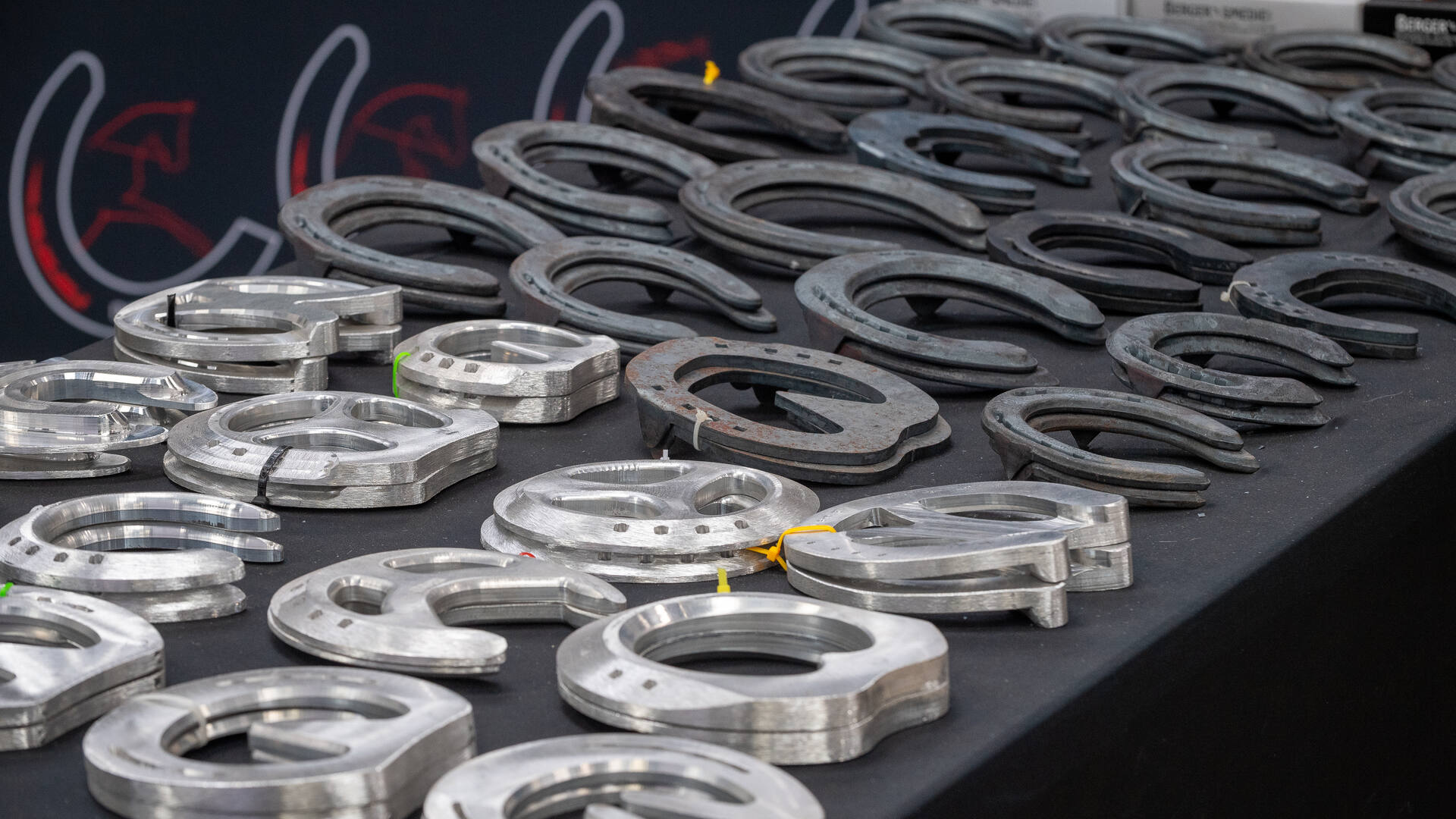
None of that is education. All of it is the job. Make that part easier and the education becomes the reason people stay rather than the reason they join. Not “pay to learn” — pay to run a better practice.
So the brief changed.
The Thing Nobody Warns You About
What that asks of the other person is enormous.
Mark has spent a working lifetime on this — the research, the book, the teaching, the reputation. The proposal on the table was: hand all of it over, let me put it inside software you can’t inspect, and trust that what comes out still has your name on it in the way you’d want.
There’s no spec document that makes that safe. It’s a judgement about a person.
Every architectural conversation was really a trust conversation wearing a hat. Where does the video live? Who owns the Stripe account? What happens to all this if you get hit by a bus? (That last one is a real document in the repo. Writing it was one of the more useful things I did, and not for technical reasons.)
How We Actually Work
We argue. We swear at each other. Properly, sometimes.
He’ll tell me a thing I’ve built is wrong. I’ll tell him the way he wants it can’t work. Neither of us is especially diplomatic about it and neither of us is right as often as we think.
What’s grown out of that, over a long time, is a fondness — and an understanding that most of the time we’re singing off the same hymn sheet. Just different songs, in different accents.
That’s the actual working relationship, and I’d take it over a polite one every day of the week. Politeness gets you a project that ships something nobody argued hard enough about.
The Job Changed Again, Halfway Through
Partway into the rebuild, Mark brought out the laminitis work.
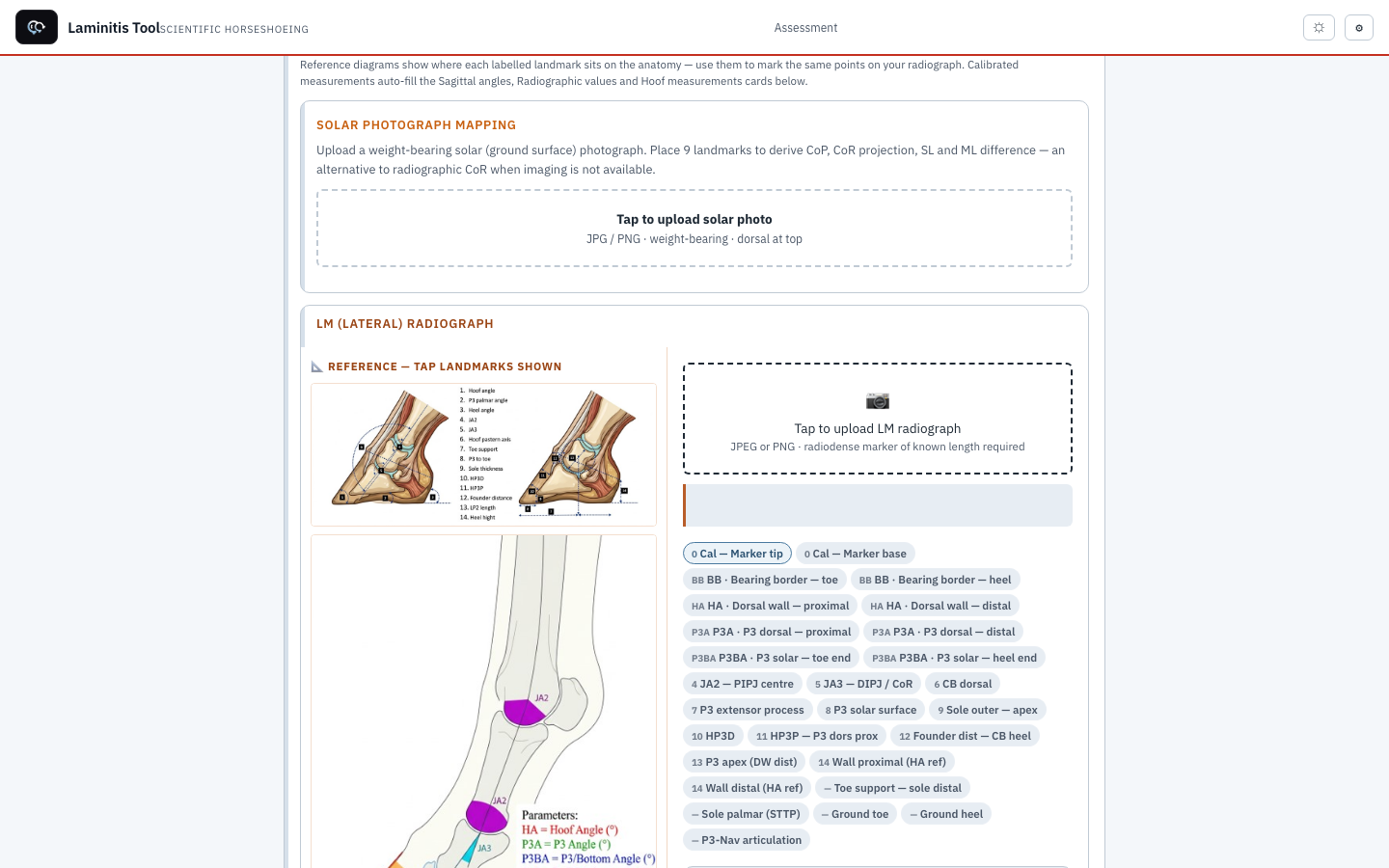
Laminitis is the condition that keeps farriers and vets awake. Assessing it properly means calibrated radiographs and real geometry — rotation, sole depth, palmar angle, breakover. He’d spent years on the clinical model and had no way of giving it to anybody except by standing in a room and teaching it, one group at a time.
He hadn’t handed that to anyone before. A website is one thing. The method you’ve spent a career refining is another. That he brought it out halfway through rather than at the start tells you roughly when the job stopped being a job.
So we built it round his maths. Place the landmarks on the radiographs, calibrate off a marker of known length, and it derives the measurements and a shoeing prescription with every safety boundary he insisted on. He still works on that engine. He’ll still find something in it he wants changed. It still isn’t finished.
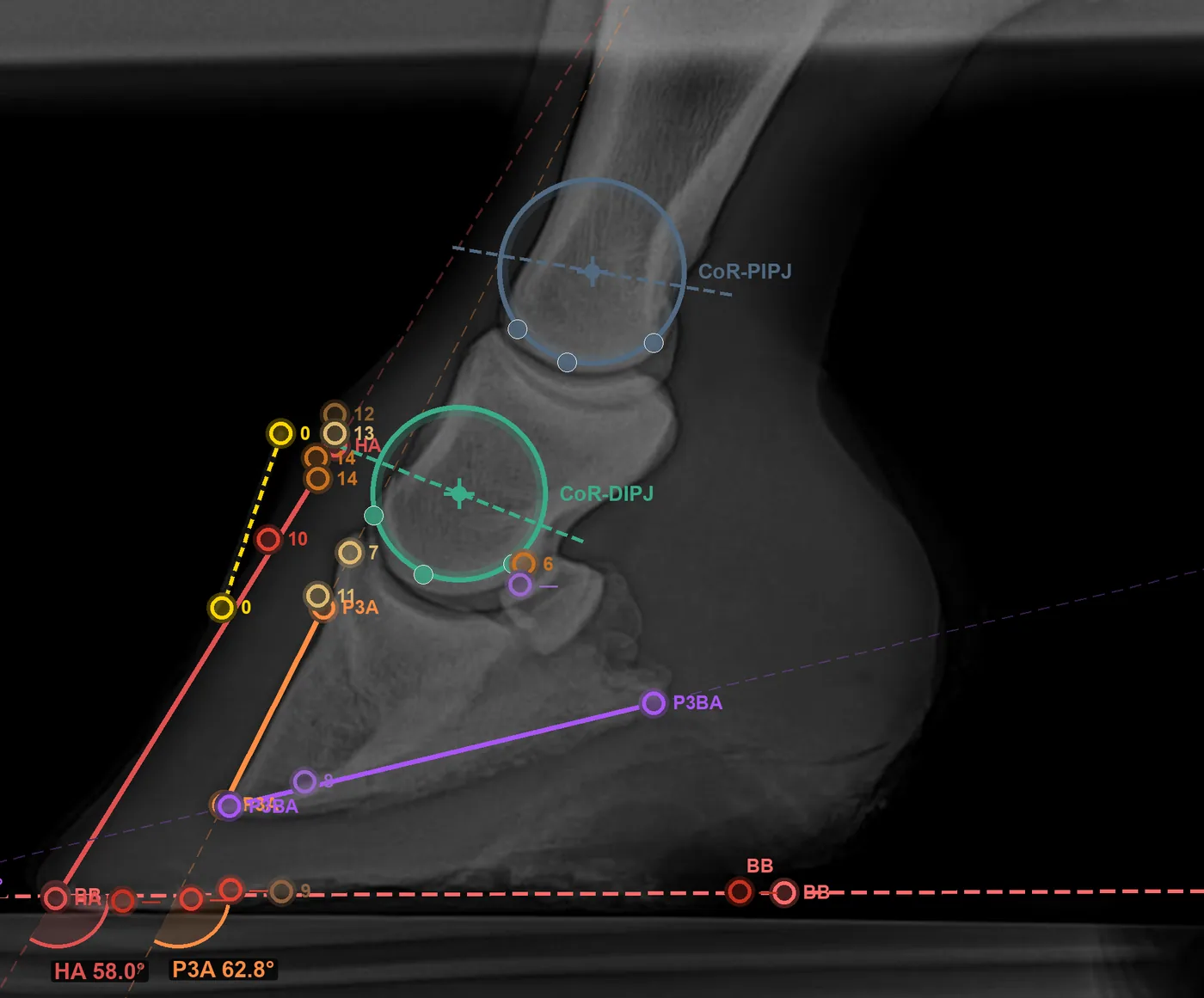
Mark’s geometry, running on somebody’s actual radiograph. Every angle on there is derived from the points the farrier taps.
And then we went and made the same mistake the rest of the business had already made: launched it on its own domain, with its own login and its own billing. Another island. We caught it before it had real users and folded it in.
Slightly embarrassing to admit in a post about fragmentation, which is why I’m admitting it. It’s an easy trap and we walked into it with our eyes open.
What It Does Now
One platform, one login, one bill. Video, structured courses, podcasts and articles in the same place, with apps on both stores.
Underneath that, the things that actually keep a professional subscribed. CPD that records itself as you learn and produces the report your governing body wants. Assessment that goes well past multiple choice — clinical scenarios that branch, radiographs you have to put a finger on, practical work an apprentice photographs for marking. More than 8,600 peer-reviewed papers you can search by meaning rather than keyword, with a checker that takes any claim an owner found online and tells you what the evidence actually says. A handout generator, so you finish a job and hand the owner something evidence-backed with your name on it. Case reviews with Mark over Zoom. A directory so clients can find you.
Then the business end: subscriptions, individual course sales, a shop, team plans for practices and colleges, and free access for verified apprentices, because the people who need it most have no money.
Teaching a Technophobe to Run Agentic Workflows
The part I’m proudest of, and it’s got nothing to do with code.
All of the above is worthless without content, and the content lives in one head. Mark is nearly 70 and a self-confessed technophobe with no interest in learning a CMS. The options were: he dictates, I type, and I’m the bottleneck forever — or I find another way.
So I gave him a direct line into the platform.
There’s a connector built into Hoofflix that his AI assistant plugs straight into. He says “I want to write an article about navicular syndrome, here are my notes”, reads it back, says “that’s too technical” as many times as he likes, then says “push that to Hoofflix as a draft” — and it lands in the admin panel for review. He has skills for articles, for building whole courses from a book chapter at any level from Diploma to Fellowship, and for finding and verifying real references. He attaches a chapter, says “do a Level 3 and a Level 5 version”, and gets two courses.
No terminal. No admin login. He talks, and it lands.
What made it work wasn’t the prompting. It was where I put the safety. Every tool on that connector can only create a draft. Nothing goes live without a human pressing Publish, and the platform throws out anything malformed regardless of what it’s told. The guardrails live in the system, not the instructions — which means Mark genuinely cannot break it, and I could tell him so honestly rather than just reassuringly.
I didn’t teach him to be careful. I built something where carelessness is harmless, and then told him the truth about it. The fear went, and what was left was a man who is very good at his subject, talking about his subject.
That’s the real story about AI adoption and it’s not the one usually told. The barrier is almost never capability. It’s being frightened of breaking something expensive in front of someone who’ll judge you for it. Remove both halves and the “technophobe” turns out to be a perfectly capable person who was in a badly designed situation.
I’m Still the Supplier
Worth being straight about what this is, because “we went into partnership” is what people say when they mean something vaguer.
Hoofflix has two directors: Dr Mark Caldwell FWCF and Neil Madden FWCF, who wrote the book between them. There are three now, and I’m the third.
But I’m still the supplier. I still build it and I still invoice for it, and the working relationship is the one it always was. The equity didn’t replace any of that. It sits alongside it, and it’s there because I believe in the thing and my name is on it now. If it’s good, that’s mine. If it’s a mess, that’s mine too.
Which is roughly the arrangement I’d want from anybody I was paying.
Where It’s Actually At
It’s live. The official launch is next week.
That isn’t the same as finished, and I won’t pretend otherwise. The laminitis tool still has work in it. The photo-based hoof analysis is being superseded by HoofScan, a companion iOS app that uses the LiDAR sensor to capture the foot in 3D and feed it into the same measurement engine — a better answer to the same problem, so the older one gets retired rather than polished. The legacy members are being moved across one at a time, carefully, because they’re real people’s real direct debits. And scientifichorseshoeing.co.uk comes down in its own time, once nothing needs it any more.
But the shape is right, and the shape was the hard part. It’s because somebody finally asked what a farrier’s whole week looks like, rather than just what a lesson looks like.
The Bit We Haven’t Built Yet
Remember the owner and the thing they found on Facebook.
That’s next. Content held to exactly the same standard as the professional material — same evidence, same rigour — but written for the horse owner, and handed over by the farrier or the vet after a visit. Not a leaflet. The actual explanation of what’s wrong with the horse, why the plan is the plan, and what to watch for.
Because the owner is going to look it up either way. At the moment they type it into Google and land on whoever has the best SEO and the loudest opinion, and then their professional spends the next visit unpicking it.
Do it properly and we become the thing they find. Dr Google, but with the evidence behind it and somebody’s actual qualifications on it — handed over by the person who has already been out to the horse.
What I’d Take From This
Tell them the truth while it still costs you something. The fortnight-in conversation is the reason there’s a platform at all.
The retention feature is rarely the headline feature. People join for the video library. They stay for the CPD report and the handout generator.
AI tooling is only as good as the safety net under it. A nearly-70-year-old technophobe runs agentic workflows here daily, not because he became technical, but because nothing he does can hurt it.
And underneath all of it: the hard part was never the database. It was a subject expert deciding, slowly, that his life’s work was safe with me — and the two of us shouting at each other often enough to find out we wanted the same thing.
If you’re spread across platforms that don’t talk to each other, or you’ve got deep expertise and no good way to get it out of your head and in front of people, that’s the sort of thing I like working on. And if the real blocker is someone on your team being frightened of the tooling, that’s solvable too.